
Building your dream home or managing a construction project in Pakistan? Imagine paying full price for branded, high-quality saria, only to discover that the steel bars delivered to your site are underweight, incorrectly marked, or not from the manufacturer you trusted. The financial loss is frustrating, but the potential risk to your building’s structural integrity is even more concerning.
Unfortunately, not every steel bar that looks genuine necessarily meets the specifications you ordered. Knowing how to identify original saria before making payment can protect your construction budget and help you avoid costly mistakes.
From checking manufacturer markings and verifying weight to recognizing suspicious dealers, a few practical inspections can make a significant difference. Before you purchase your next batch of steel bars, here’s what every homeowner, builder, and contractor should know.
What Is Fake or Underweight Saria in Pakistan?
Fake or underweight saria refers to steel reinforcement bars that are misrepresented, incorrectly specified, or supplied with less material than the buyer was promised. Although these problems are often discussed together, they are not exactly the same.
Fake saria in Pakistan may involve steel bars sold under an unauthorized brand name, products carrying misleading manufacturer markings, or reinforcement advertised as meeting a particular grade without reliable supporting evidence.
Underweight saria, on the other hand, refers to steel bars that weigh less than the expected amount for their specified diameter, length, and applicable standard. A weight discrepancy does not automatically prove fraud, because manufacturing standards allow certain tolerances. However, unexplained or excessive differences deserve investigation.
Common Saria Weight Cheating and Dealer Fraud Practices
Buyers should watch for several possible forms of misrepresentation:
- Selling smaller-diameter steel bars as larger sizes.
- Supplying shorter bars while charging for the agreed length.
- Using unauthorized markings that imitate established steel brands.
- Charging for a higher steel grade while supplying an unverified product.
- Providing inaccurate weight slips or invoices.
- Mixing different manufacturers’ bars in one delivery without disclosure.
These practices can make it difficult for customers to know exactly what they are purchasing.
For anyone building a house, commercial plaza, or industrial facility, identifying such warning signs before payment is far easier than resolving a dispute after the steel has been delivered or installed.
How to Identify Original Saria: 6 Checks Before Buying
The most reliable way to identify original saria is to verify its manufacturer, dimensions, weight, steel grade, and purchase documentation together. No single visual test can establish authenticity or compliance.
Here are six practical checks you should perform before accepting a steel delivery.
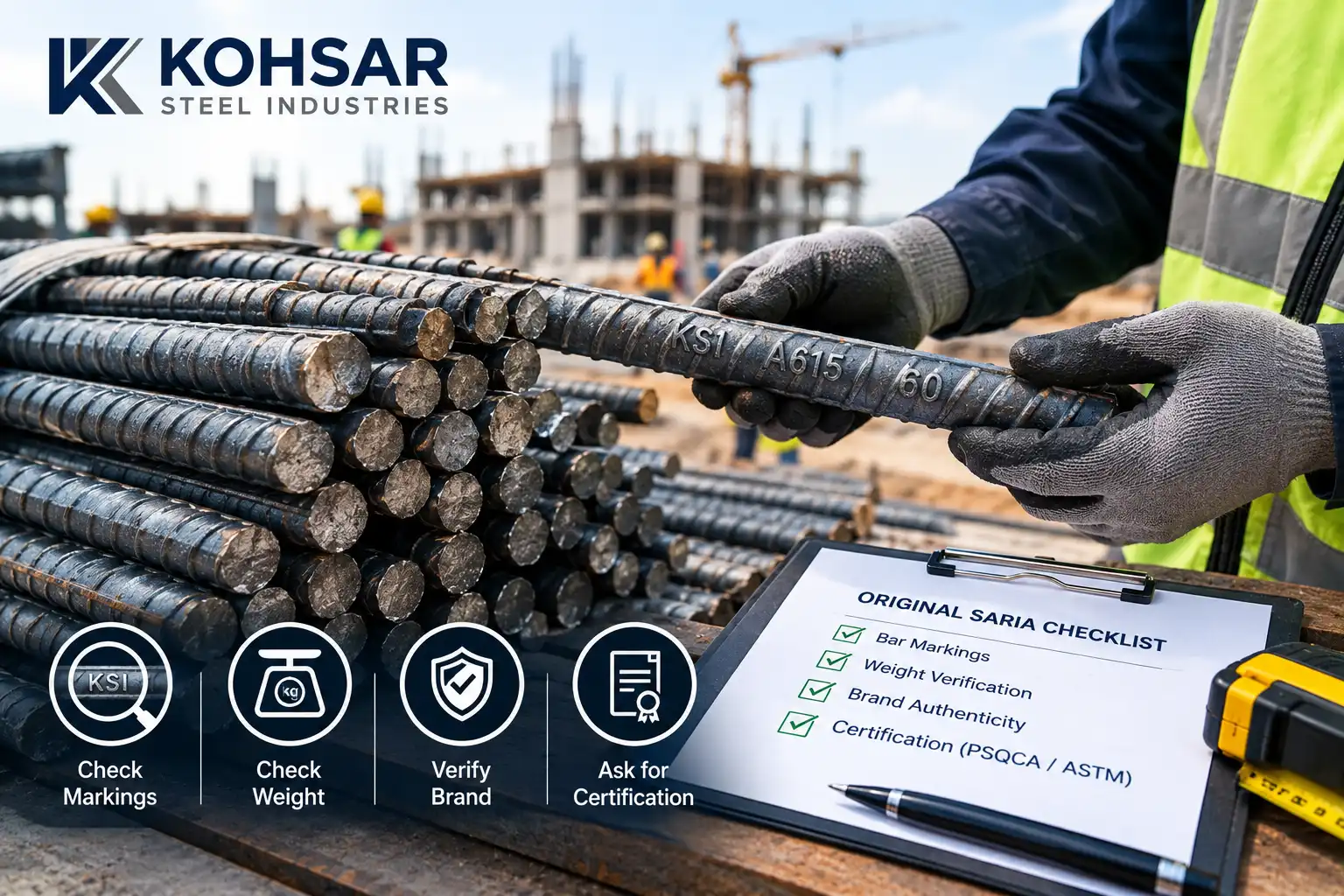
1. Check the Manufacturer’s Brand Markings
A saria brand marking check is one of the first steps in identifying potentially counterfeit reinforcement bars.
Many reputable steel manufacturers use rolled markings on their products to indicate manufacturer identity, grade, bar designation, or other details required by the applicable standard.
Before purchasing, examine several bars from the same bundle.
Look for markings that are consistent with the manufacturer’s published identification system. If the lettering, symbols, or grade identification appears unusual, request clarification from the manufacturer.
Remember that markings vary between brands and standards. A particular logo or marking style should not be treated as universal proof of authenticity.
Most importantly, a copied brand marking can still appear convincing. Always verify suspicious products directly with the manufacturer.
2. Verify the Steel Bar Diameter and Length
Steel bars are commonly purchased according to their nominal diameter and length. Even a small difference in the actual dimensions can affect the amount of steel supplied.
For example, if you order 16mm reinforcement bars but receive bars with a smaller equivalent cross-sectional area, you may be paying for more steel than you actually receive.
Use a suitable measuring instrument, such as a vernier caliper, and check the bars against the applicable product specification.
For ribbed reinforcement, remember that measuring across the raised ribs does not necessarily give the nominal diameter. Measurements should follow the relevant standard, and weight per metre can provide an additional cross-check.
Also confirm that the supplied bar lengths match your purchase order.
3. Compare Actual Weight With Standard Saria Weight
One of the most useful ways to detect potential saria weight cheating is to compare the measured weight with the theoretical or specified nominal weight.
Ask the dealer to weigh a representative sample using a properly calibrated scale.
Then compare the result with the expected weight for that bar size and length.
For instance, a nominal 16mm steel bar has a theoretical weight of approximately 1.58 kg per metre. A 12-metre bar would therefore weigh approximately 18.96 kg before accounting for rounding and applicable manufacturing tolerances.
If the actual weight differs significantly, ask the supplier to explain the discrepancy before accepting the delivery.
4. Inspect the Surface, Ribs, and Physical Condition
Original steel bars should be consistent with the manufacturer’s declared product specifications.
Examine the bars for unusual differences in rib patterns, visible cracks, severe corrosion, damaged sections, or inconsistent dimensions.
Minor surface rust does not necessarily make reinforcement unsuitable. However, significant corrosion, scaling, or physical damage should be evaluated before the steel is used.
Also, avoid relying on colour, shine, or appearance alone. Genuine steel bars can have different surface appearances depending on manufacturing and storage conditions.
Visual inspection is useful for identifying potential problems, but it cannot confirm chemical composition or mechanical strength.
5. Request a Mill Test Certificate and Proper Invoice
A mill test certificate, commonly called an MTC, provides important information about a steel product’s reported specifications and testing.
Depending on the manufacturer and applicable standard, it may include:
- Manufacturer identification.
- Steel grade and relevant standard.
- Heat or batch identification.
- Chemical composition results.
- Yield strength and tensile strength.
- Elongation or other mechanical test results.
Ask whether the certificate can be matched to the bars being supplied through their heat number, batch details, or accompanying documentation.
Your invoice should also clearly identify the product, grade, size, quantity, agreed price, and supplier.
A certificate alone is not conclusive if its origin or connection to the delivered steel cannot be verified.
6. Confirm the Dealer and Manufacturer’s Authenticity
Even when a steel bar carries recognizable markings, it is important to verify where it came from.
Ask the seller for business details, purchase documentation, and evidence that the material originated from the claimed manufacturer.
For larger construction orders, contact the manufacturer directly to confirm whether the supplier is an authorized distributor or whether the product details can be authenticated.
Be cautious if a dealer refuses to provide documentation, discourages weighing, or insists on immediate payment without allowing reasonable inspection.
The safest buying decision is based on multiple checks, not simply the brand name printed on the bar.
How to Check Saria Weight and Avoid Underweight Steel Bars
When purchasing reinforcement steel, understanding how weight is calculated can help you identify unusual differences before they become expensive problems.
Saria Weight Calculation Formula
A commonly used theoretical formula for calculating the mass of a round steel bar is:
Weight(kg/m)D2162
Where D represents the nominal diameter of the steel bar in millimetres.
For example, a 12mm bar has an approximate theoretical weight of:
1221620.889kg/m
For a 12-metre bar:
0.8891210.67kg
This formula is useful for preliminary checking, but it does not replace the nominal mass requirements of the applicable manufacturing standard.
Expected Weight of Common Saria Sizes in Pakistan
| Nominal diameter | Approx. weight per metre | Approx. weight for 12 metres |
| 10mm | 0.617 kg | 7.41 kg |
| 12mm | 0.889 kg | 10.67 kg |
| 16mm | 1.580 kg | 18.96 kg |
| 20mm | 2.469 kg | 29.63 kg |
| 25mm | 3.858 kg | 46.30 kg |
These are approximate theoretical weights calculated using nominal metric diameters. Actual specified nominal weights depend on the product designation and manufacturing standard. For example, ASTM bar designations do not always correspond exactly to the rounded metric sizes shown above.
For technical specifications, you can also review the ASTM steel bar weight and quality standards published by Kohsar Steel Industries. These include nominal mass, dimensions, and mechanical requirements for relevant reinforcement bar designations.
What to Do if the Actual Weight Is Lower
If you suspect saria mein weight ki kami, don’t immediately assume the material is counterfeit.
First, confirm the nominal bar designation, actual length, scale accuracy, and applicable weight tolerance.
Next, weigh several representative bars rather than relying on a single sample.
If the difference remains unexplained, request the manufacturer’s specifications and supporting test documents.
For structural applications, consult your engineer before accepting material that appears to fall outside the required specifications.
A lower weight may indicate a dimensional issue, but it does not independently establish whether a bar meets its mechanical strength requirements.
Original vs Fake Steel Bars: Warning Signs You Should Never Ignore
When comparing original vs fake steel bars, certain warning signs can help you identify a potentially unreliable purchase.
Counterfeit products may resemble genuine branded reinforcement, making it difficult to distinguish them through appearance alone.
The following comparison highlights what buyers should investigate.
| Buying indicator | Potential warning sign |
| Manufacturer markings match verified brand specifications | Unusual, inconsistent, or unverifiable markings |
| Weight is consistent with the applicable standard | Unexplained or excessive weight differences |
| Product grade is supported by documentation | Grade claims without supporting evidence |
| Supplier provides a detailed invoice | Missing or incomplete purchase records |
| Dealer allows reasonable product inspection | Dealer discourages weighing or verification |
| Product origin can be traced | Manufacturer or supply chain cannot be confirmed |
Can Duplicate Saria Brands in Pakistan Look Original?
Yes. Steel bars carrying unauthorized or copied manufacturer markings may look similar to genuine products.
This is why buyers should not rely exclusively on a stamped brand name.
A reliable authenticity check involves confirming the markings, supplier credentials, product specifications, and available manufacturing documentation.
If you suspect a duplicate product, contact the manufacturer before completing the purchase.
How to Avoid Fake Saria and Dealer Fraud in Pakistan
Knowing how to avoid fake saria is especially important when purchasing large quantities for residential or commercial construction.
Steel represents a significant investment, and even a seemingly attractive deal can become expensive if the delivered material does not match the agreed specifications.
Buy From Verified Steel Manufacturers or Dealers
Purchase reinforcement from an established manufacturer or a dealer whose identity and supply chain can be verified.
Before placing an order, confirm the seller’s business details and request information about the manufacturer.
A reputable supplier should be able to explain the available steel grades, sizes, product specifications, and purchase terms.
Confirm Brand, Grade, Weight, and Price Before Payment
An unusually low quotation can be tempting, especially when construction costs are increasing.
However, a lower price does not automatically mean better value.
Compare quotations based on equivalent specifications, including steel grade, nominal diameter, applicable standard, quantity, and delivery conditions.
You can check the steel prices in Pakistan published by Kohsar Steel Industries to understand how steel rates vary according to product specifications and purchasing requirements.
Remember that steel prices change with market conditions, so always request an updated quotation before purchasing.
Keep Purchase Records and Verify Delivery
Before releasing final payment, make sure the delivered material matches your purchase order.
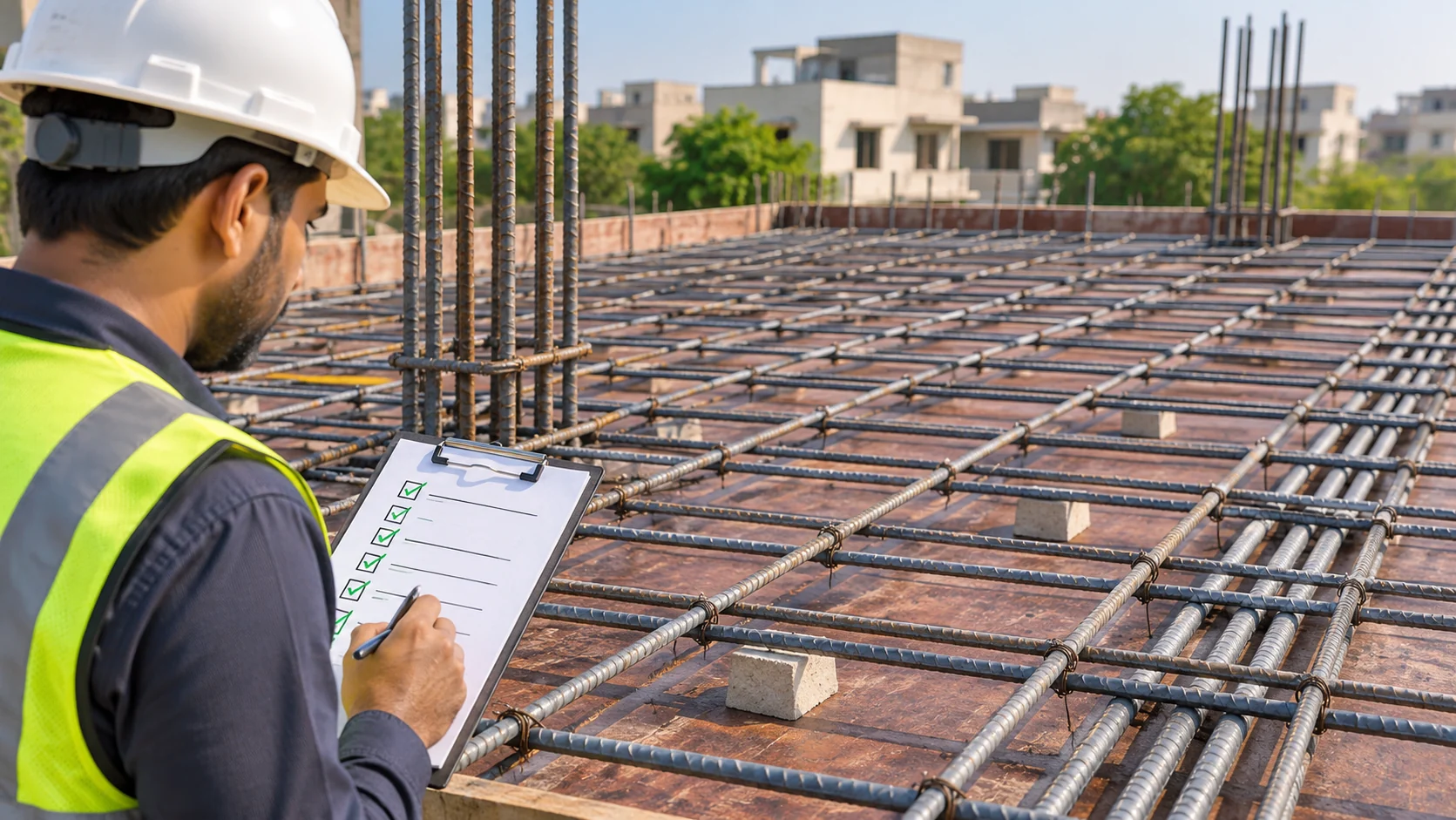
Use this simple checklist:
Saria Prepayment Checklist
0 of 6 checked:
- Manufacturer and supplier verified
- Steel grade and bar size confirmed
- Brand markings inspected
- Bar length and sample weight checked
- Invoice and relevant test documentation reviewed
- Delivered quantity matched with purchase order
- Copy checklist
If anything appears inconsistent, pause the transaction and request clarification.
Taking a few extra minutes to verify your purchase can help prevent disputes, unnecessary expenses, and construction delays.
Why Steel Quality and Proper Testing Matter for Construction Safety
Reinforcement steel plays a critical role in helping concrete structures resist tensile forces.
Its performance depends on several factors, including steel grade, cross-sectional area, mechanical properties, reinforcement placement, and the overall structural design.
For example, Grade 40 and Grade 60 reinforcement have different specified minimum yield strengths.
Grade 40 has a minimum yield strength of approximately 280 MPa, while Grade 60 has a minimum yield strength of approximately 420 MPa under the commonly referenced ASTM classifications.
However, a heavier steel bar is not automatically stronger in terms of steel grade. Two bars with the same nominal diameter can have similar theoretical weights but different mechanical properties.
For projects requiring higher-strength reinforcement, explore the specifications of Grade 60 steel bars in Pakistan offered by Kohsar Steel Industries.
The correct steel grade and diameter should always be selected according to the structural engineer’s approved design.
Proper material testing helps confirm that reinforcement meets the specified requirements before it becomes part of a building’s structure.
Buy Quality Steel Bars With Confidence From Kohsar Steel Industries
When investing in construction, you deserve to know what you are paying for.
At Kohsar Steel Industries, we understand that steel quality, product consistency, and dependable supply matter to homeowners, contractors, and developers across Pakistan.
Our manufacturing process incorporates chemical testing, billet inspection, rolling, and physical testing as part of our published quality-control procedures.
We manufacture Grade 40 and Grade 60 reinforcement products and provide steel solutions for residential, commercial, and industrial construction requirements.
Whether you are purchasing reinforcement for a new home or planning a larger project, choosing the right steel specifications is an important step toward dependable construction.
Explore our range of Kohsar Steel Industries steel products and discuss your required grade, bar size, quantity, and supporting documentation with our team.
Don’t compromise on the steel behind your structure. Contact Kohsar Steel Industries at +92 322 444 7999 or email info@kohsarsteelindustries.com to discuss your construction steel requirements and request a quotation.
Final Thoughts
Buying reinforcement steel should never be based on price or brand appearance alone.
Understanding how to identify original saria gives you greater confidence when comparing steel suppliers, inspecting deliveries, and making purchasing decisions.
Always verify manufacturer markings, bar dimensions, weight, steel grade, and supporting documentation before accepting a shipment.
If something seems suspicious, ask questions before making payment rather than discovering the problem after construction begins.
Your building deserves steel that meets its design requirements, and your investment deserves careful protection.
Choose quality, verify before you buy, and build with confidence with Kohsar Steel Industries.
Frequently Asked Questions
Q 1. Asli aur nakli saria ki pehchan kaise karein?
Ans: Asli aur nakli saria ki pehchan ke liye manufacturer ki marking, saria ka weight, diameter, length aur steel grade check karein. Dealer se original invoice aur mill test certificate bhi maangein. Agar brand marking ya weight mein koi shak ho, to payment se pehle manufacturer se tasdeeq karein.
Q 2. Saria mein weight ki kami kaise check karein?
Ans: Saria mein weight ki kami check karne ke liye steel bar ki actual length aur weight measure karein. Phir uska comparison relevant standard ke nominal weight se karein. Metric bar ka approximate theoretical weight nikalne ke liye D²/162 formula use kiya ja sakta hai, jahan D diameter millimetres mein hota hai. Applicable manufacturing tolerances ko bhi consider karna zaroori hai.
Q 3. Nakli saria se kaise bachen?
Ans: Nakli saria se bachne ke liye verified manufacturer ya trusted dealer se purchase karein. Brand marking, steel grade, weight, invoice aur test documentation check karein. Sirf kam price dekh kar saria na khareedein. Agar product ki authenticity par shak ho, to manufacturer se direct confirmation lein.
Q 4. How Can I Verify Saria Brand Markings in Pakistan?
Ans: Check the rolled manufacturer identification and grade markings against the manufacturer’s official product information. Because markings vary by standard and brand, contact the manufacturer if you cannot verify them. Brand markings should also be supported by reliable purchase documentation.
Q 5. Can Underweight Saria Be Used in Construction?
Ans: An underweight steel bar should not automatically be accepted or rejected without checking the applicable standard and permitted tolerances. If the material falls outside the required specifications, it should not be installed without evaluation and approval by the responsible structural engineer. Weight alone cannot confirm the bar’s mechanical strength.
Q 6. Does Grade 60 Saria Weigh More Than Grade 40 Saria?
Ans: Not necessarily. Grade 40 and Grade 60 refer primarily to mechanical strength classifications, not bar weight. When both bars have the same nominal diameter, length, and applicable dimensional specifications, their theoretical weights are essentially the same. Their specified yield strengths are different.