
When building a house, commercial plaza, or any concrete structure in Pakistan, choosing good-quality saria (steel reinforcement bars) is one of the most important decisions you can make. Steel bars provide tensile strength to reinforced concrete, helping structural elements resist loads and stresses.
But how can you tell whether the saria delivered to your construction site is genuine and meets the required standards?
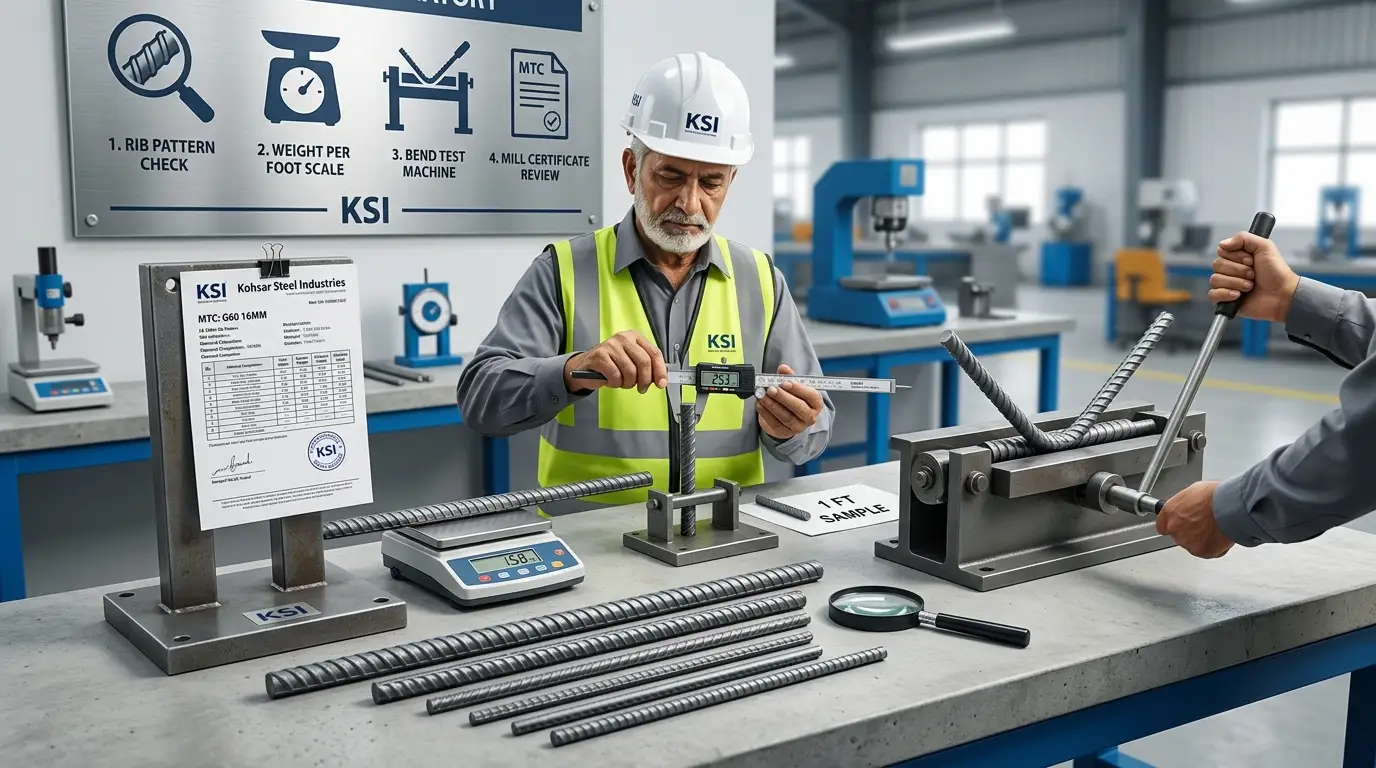
If you’re wondering how to check saria quality, you don’t need to be a steel expert to perform some basic inspections. By checking the rebar rib pattern, weight per foot, surface condition, and mill test certificate, you can identify potential quality problems before the steel is used.
In this guide, we’ll explain how to identify good quality steel bars, which checks you can perform yourself, and when professional laboratory testing is necessary.
Why Is Checking Saria Quality Important?
Saria is used in foundations, columns, beams, slabs, and other reinforced concrete components. Poor-quality reinforcement can affect the strength, durability, and safety of a building.
Using steel bars that do not meet the required specifications may lead to:
- Reduced structural strength and load-bearing performance
- Poor bonding between steel and concrete
- Increased risk of cracking and structural damage
- Problems during bending and reinforcement installation
- Costly repairs or construction delays
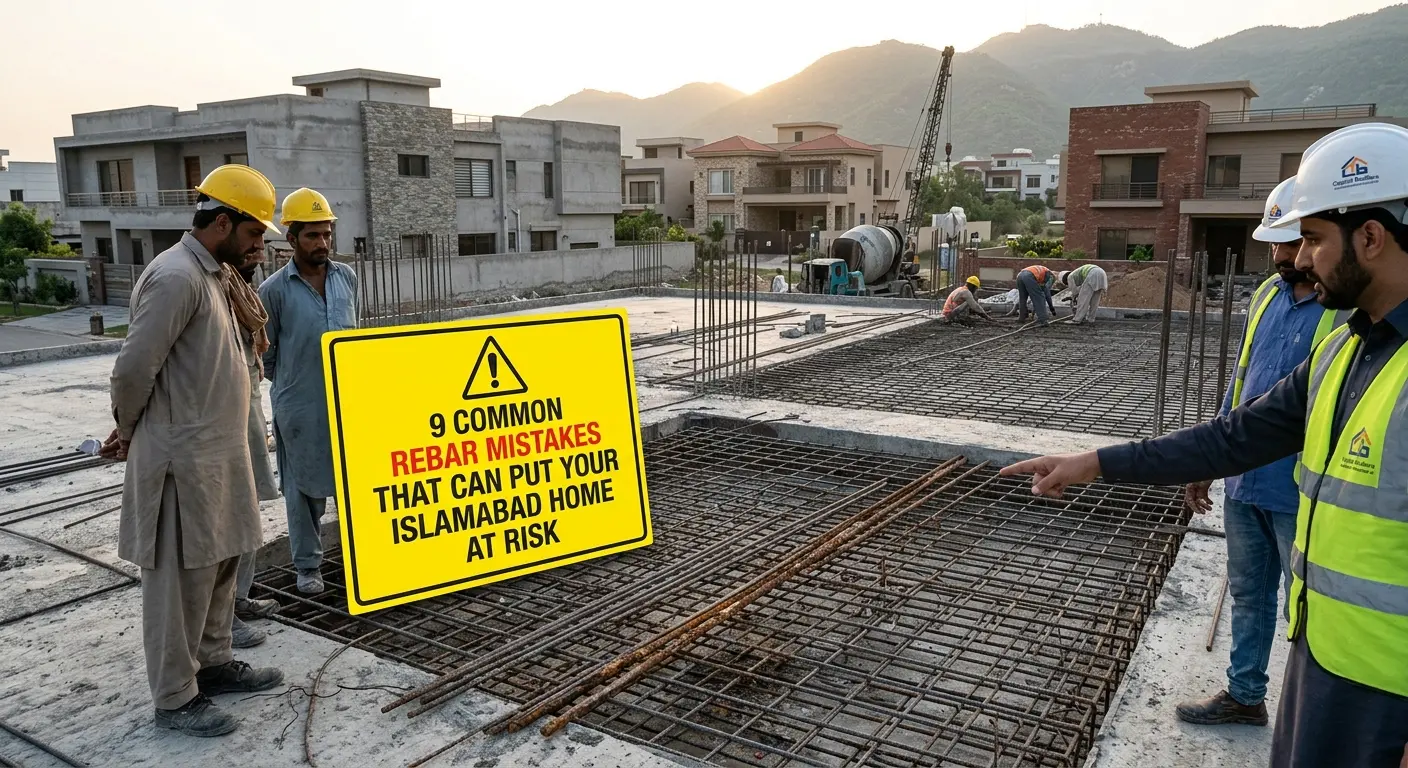
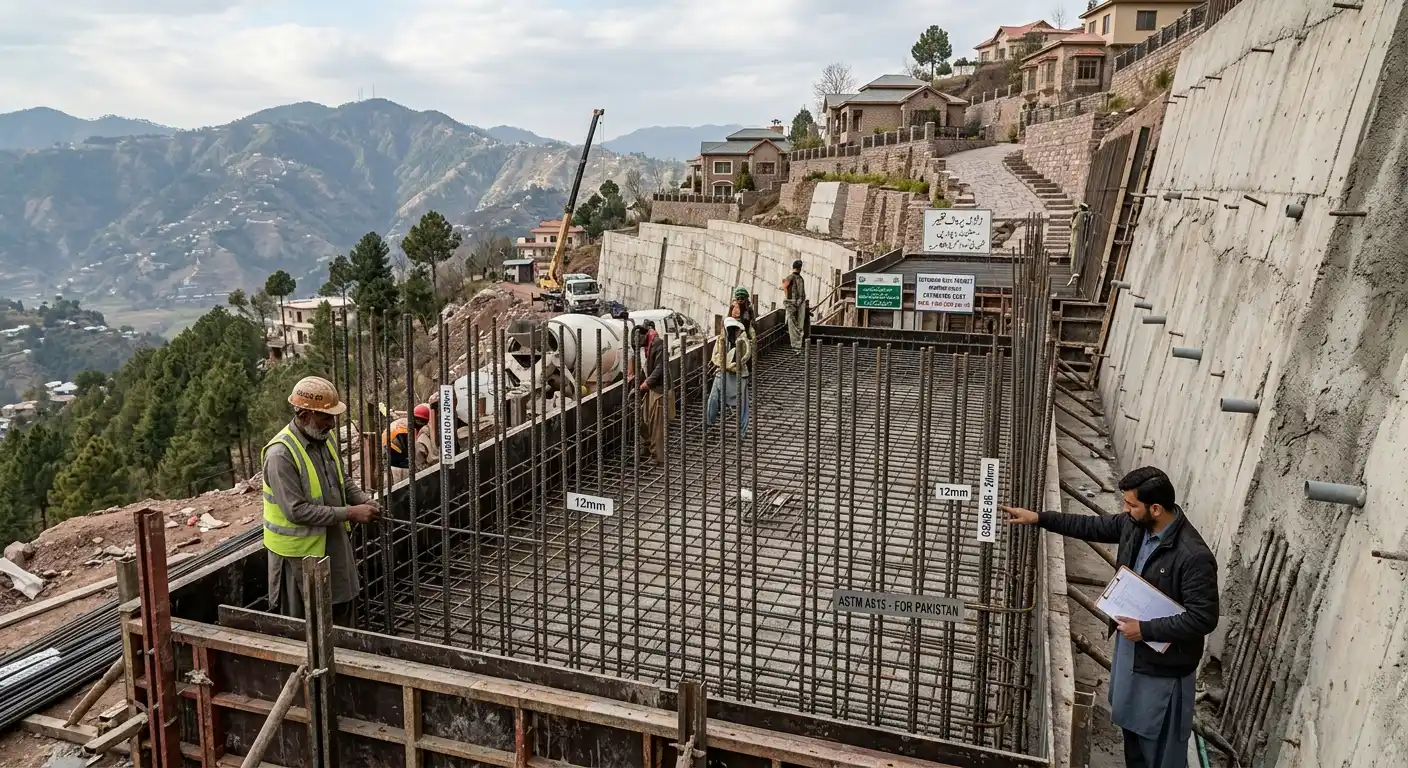
For these reasons, a saria quality check at site should be part of the material inspection process before construction begins.
Remember that appearance alone cannot prove steel quality. Basic site checks help identify suspicious material, while certified laboratory tests and proper documentation provide stronger evidence of compliance.
1. Check the Rebar Rib Pattern
One of the first things to examine when checking saria quality is the surface of the steel bar.
Most reinforcing steel used in reinforced concrete construction has raised patterns called ribs or deformations. These help improve the mechanical bond between the steel and surrounding concrete.
What Does a Good Rebar Rib Pattern Look Like?
When inspecting the rebar rib pattern, look for:
- Clearly formed ribs along the bar
- A consistent pattern throughout its length
- No large sections with missing or badly damaged ribs
- No obvious rolling defects or unusual surface irregularities
- Manufacturer identification and grade markings where required by the applicable standard
Different manufacturers and standards may use different rib designs. Therefore, a particular rib shape does not automatically indicate superior quality.
How to Check Saria Ribs at Site
Place a few bars on a clean surface and examine them under good lighting.
Compare bars of the same size and grade from the same delivery. Look for significant differences in rib formation, unusual flattening, or visible manufacturing defects.
You should also check for deep corrosion pits, cracks, and other visible damage.
Minor surface rust does not necessarily make reinforcement unsuitable, but heavy corrosion or reduced cross-section requires further evaluation.
Important: A well-formed rib pattern is a useful visual indicator, not proof of the bar’s tensile strength or chemical composition.
2. Check Saria Weight per Foot
Another practical method for checking steel bar quality at site is measuring the weight of the reinforcement bars.
Steel bars are manufactured according to specified nominal dimensions and mass requirements. If a bar is significantly lighter than its expected weight, it may be undersized or otherwise outside the permitted tolerances.
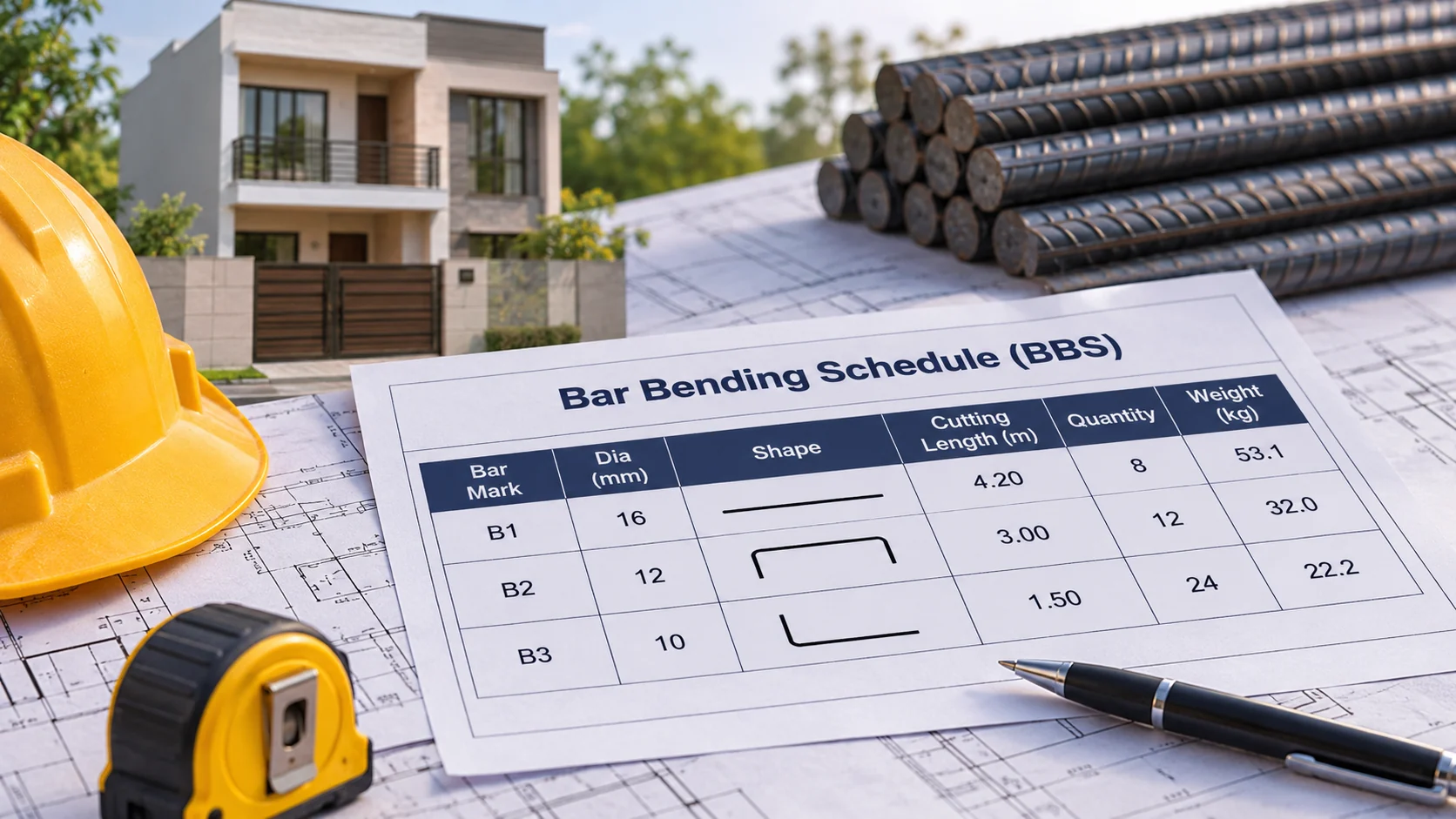
Standard Saria Weight per Foot Chart
The following table provides approximate theoretical weights for commonly used nominal metric bar diameters.
| Saria Diameter | Approx. Weight per Foot | Approx. Weight per Meter |
| 8 mm | 0.120 kg | 0.395 kg |
| 10 mm | 0.188 kg | 0.617 kg |
| 12 mm | 0.271 kg | 0.889 kg |
| 16 mm | 0.482 kg | 1.580 kg |
| 20 mm | 0.753 kg | 2.469 kg |
| 25 mm | 1.176 kg | 3.858 kg |
Note: These are theoretical values calculated from nominal metric diameters. Actual standardized rebar sizes, nominal weights, and permitted tolerances depend on the applicable specification. For ASTM-designated bars, use the corresponding ASTM weight table rather than assuming that a rounded metric diameter is exact.
How to Measure Saria Weight Yourself
Follow these simple steps:
- Select a representative steel bar from the delivered batch.
- Measure its actual length using a measuring tape.
- Weigh the bar using a properly calibrated scale.
- Divide the total weight by the measured length in feet.
- Compare the result with the nominal mass and permitted tolerance for the specified bar size and standard.
Formula:
Weight per foot = Total bar weight (kg) ÷ Bar length (feet)
Example: Checking a 12 mm Bar
Suppose you have a nominal 12 mm steel bar measuring 40 feet.
Using the approximate theoretical value:
Expected weight = 0.271 × 40
Expected weight ≈ 10.84 kg
If the measured weight is substantially lower, investigate the bar’s actual designation, dimensions, and applicable mass tolerance.
However, a heavier bar is not automatically stronger, and a small difference from theoretical weight does not necessarily mean the steel has failed quality requirements.
For a reliable assessment, compare the measured result with the relevant standard and purchase specifications.
3. Understand the Rebar Bend Test
The rebar bend test evaluates whether reinforcement steel can withstand a specified degree of bending without developing unacceptable cracks.
Bend performance is important because reinforcement bars often need to be shaped into stirrups, hooks, and other configurations for construction.
How Is a Rebar Bend Test Performed?
In a standardized laboratory bend test:
- A representative steel sample is selected.
- The sample is positioned in an approved bending apparatus.
- The bar is bent around a specified pin or mandrel.
- The required bend angle and pin diameter are selected according to the relevant standard, bar size, and grade.
- The bent portion is inspected for cracks or other signs of failure.
The test helps assess the steel’s ability to deform under prescribed conditions.
Can You Perform a Bend Test Yourself?
You may observe how reinforcement behaves during normal, approved fabrication, but manually bending a random bar is not a reliable substitute for a standardized test.
Never attempt to bend heavy reinforcement using improvised tools or unsafe methods.
If you notice cracking, splitting, or unusual behavior during fabrication, stop using the affected material and consult your site engineer.
A proper bend test should be conducted by trained personnel using suitable equipment and the correct testing procedure.
Remember: Passing a bend test does not automatically establish that the steel meets all tensile strength, chemical composition, or dimensional requirements.
4. Ask for the Mill Test Certificate for Rebar
A mill test certificate for rebar, also called a mill test report (MTR) or material test certificate, is one of the most important documents to request when purchasing steel.
It provides information about the manufactured material and its reported test results.
What Should a Mill Test Certificate Include?
Depending on the manufacturer and applicable specification, a mill test certificate may contain:
- Manufacturer’s name
- Steel grade and applicable standard
- Heat number or batch identification
- Bar size or product designation
- Chemical composition results
- Yield strength
- Tensile strength
- Elongation results
- Relevant bend test results or compliance information
- Date of testing and authorized verification details
How to Verify a Mill Test Certificate
Start by checking that the certificate matches the material you received.
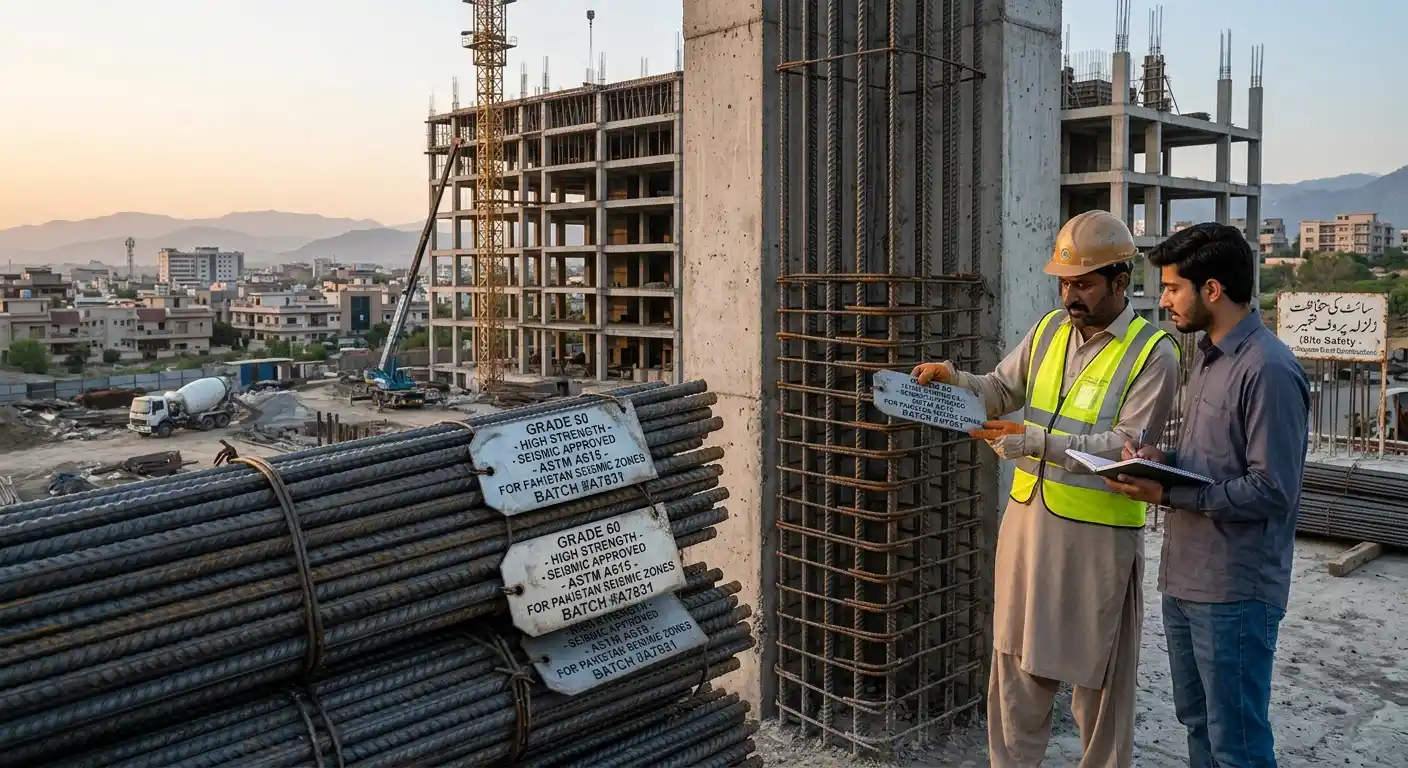
Compare the heat number, grade, bar designation, and other identification details with the bundle tags and delivery documentation.
Next, verify that the reported test results meet the requirements of the standard specified for your project.
For example, Grade 60 reinforcement under ASTM A615 has a specified minimum yield strength of 60,000 psi, approximately 420 MPa.
A certificate showing appropriate strength values is useful, but the document must also be authentic and traceable to the delivered batch.
If the certificate is missing, inconsistent, or cannot be verified, request clarification from the supplier before accepting the material.
For a better understanding of steel grades and technical requirements, explore the ASTM standard steel bars and specifications provided by Kohsar Steel Industries.
5. Understand the Rebar Tensile Test
A rebar tensile test is a laboratory procedure used to measure how steel behaves when subjected to a pulling force.
Unlike visual inspection, tensile testing provides measurable information about the mechanical properties of reinforcement steel.
What Does a Tensile Test Measure?
A tensile test commonly evaluates three important properties.
Yield Strength
Yield strength indicates the stress level at which steel begins to undergo significant permanent deformation, as defined by the applicable testing method.
Tensile Strength
Tensile strength is the maximum engineering stress reached during the tensile test.
Elongation
Elongation measures how much a steel specimen stretches over a specified gauge length before fracture. It provides information about the material’s ductility.
Why Does Tensile Testing Matter?
A steel bar may look perfectly normal from the outside but still fail to meet the required mechanical properties.
This is why visual inspection and weight measurements cannot replace laboratory testing.
For structural projects, tensile testing should be arranged when required by the project specifications, applicable standards, or the supervising engineer.
Grade 40 vs Grade 60: Does Steel Grade Affect Quality?
Many buyers in Pakistan assume that Grade 60 saria is always better than Grade 40 because it has a higher specified yield strength.
However, the correct grade depends on the structural design and applicable construction requirements.
| Property | Grade 40 | Grade 60 |
| Minimum yield strength | 40,000 psi | 60,000 psi |
| Approximate metric yield strength | 280 MPa | 420 MPa |
| Minimum tensile strength under ASTM A615 | 60,000 psi | 90,000 psi |
| Selection | As specified by the structural engineer | As specified by the structural engineer |
Grade 60 offers higher specified yield strength, but this does not mean that every Grade 60 bar is suitable for every application or that Grade 40 is inherently poor quality.
Both grades can be appropriate when manufactured to the required standard and used according to the approved structural design.
You can learn more about Grade 40 steel bars in Pakistan and explore the specifications of Grade 60 steel bars at Kohsar Steel Industries.
Saria Ki Quality Kaise Check Karen?
Pakistan mein ghar banate waqt aksar log poochte hain: Saria ki quality kaise check karen?
Agar aap asli saria ki pehchan karna chahte hain, to kuch basic cheezein zaroor check karein.
1. Saria ke ribs check karein
Saria par bani hui lines ya ribs saaf aur consistent honi chahiye. Agar ribs damage hain ya steel par unusual cracks nazar aa rahe hain, to material ko mazeed check karwana chahiye.
2. Saria ka wazan check karein
Saria ki length aur weight measure karein. Phir uska weight per foot calculate karke relevant standard ke mutabiq compare karein.
3. Steel grade aur markings dekhein
Saria ki grade, manufacturer ki identification aur bundle details check karein. Sirf dekhne se steel ki asli strength confirm nahi hoti.
4. Mill test certificate maangein
Supplier se mill test certificate lein aur check karein ke us par likhi hui grade aur heat number delivered saria se match karte hain.
5. Zaroorat par laboratory test karwayein
Agar steel ki quality par doubt ho, to engineer ke mashware se authorized laboratory mein bend test aur tensile test karwayein.
Achi saria ki pehchan sirf uski chamak, rang ya wazan se nahi hoti. Asal quality ka pata proper specifications, reliable documentation aur testing se chalta hai.
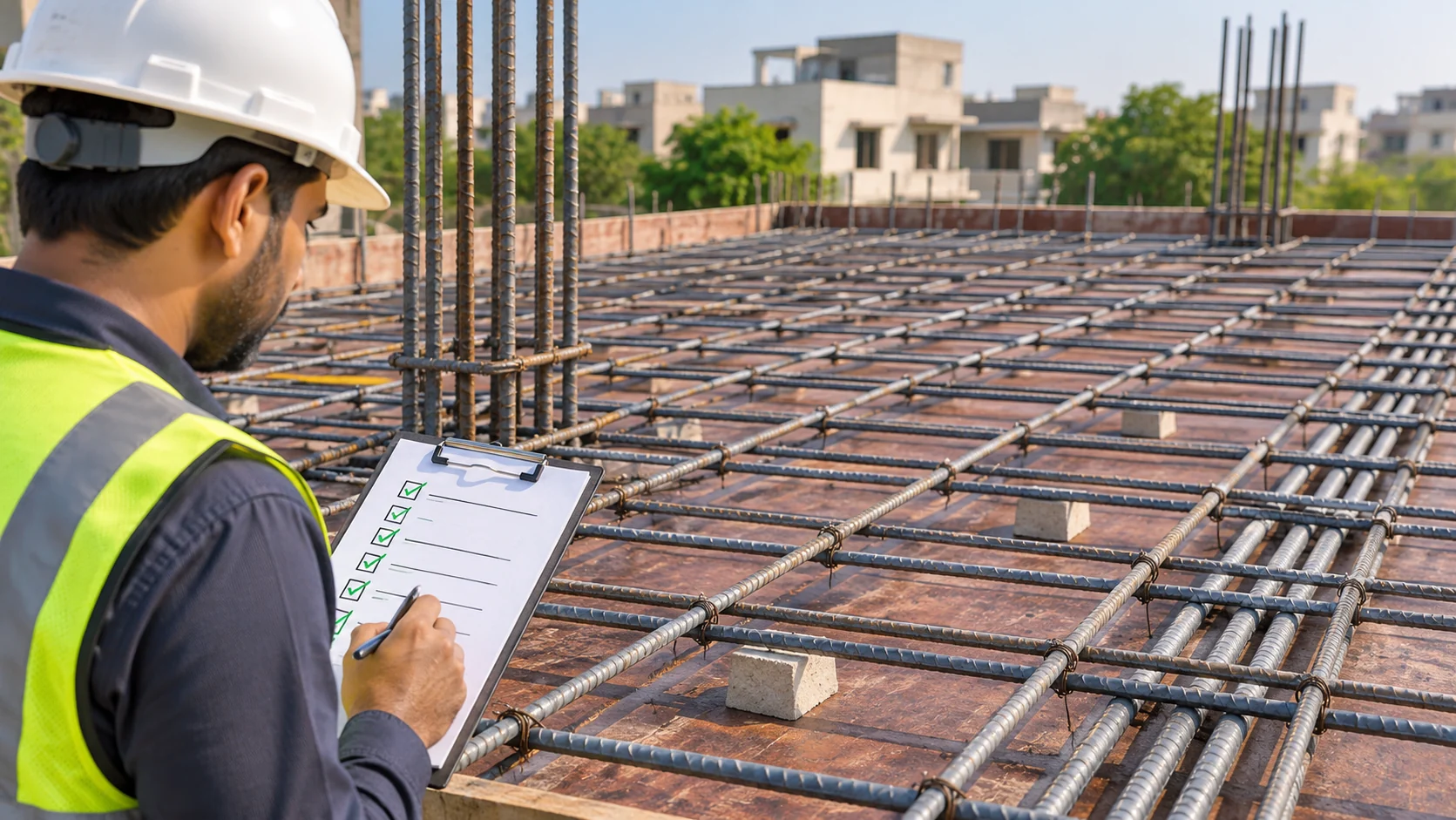
Quick Saria Quality Check at Site: Practical Checklist
Before accepting reinforcement steel for your construction project, use this checklist:
- Confirm the steel grade and bar size against the approved drawings.
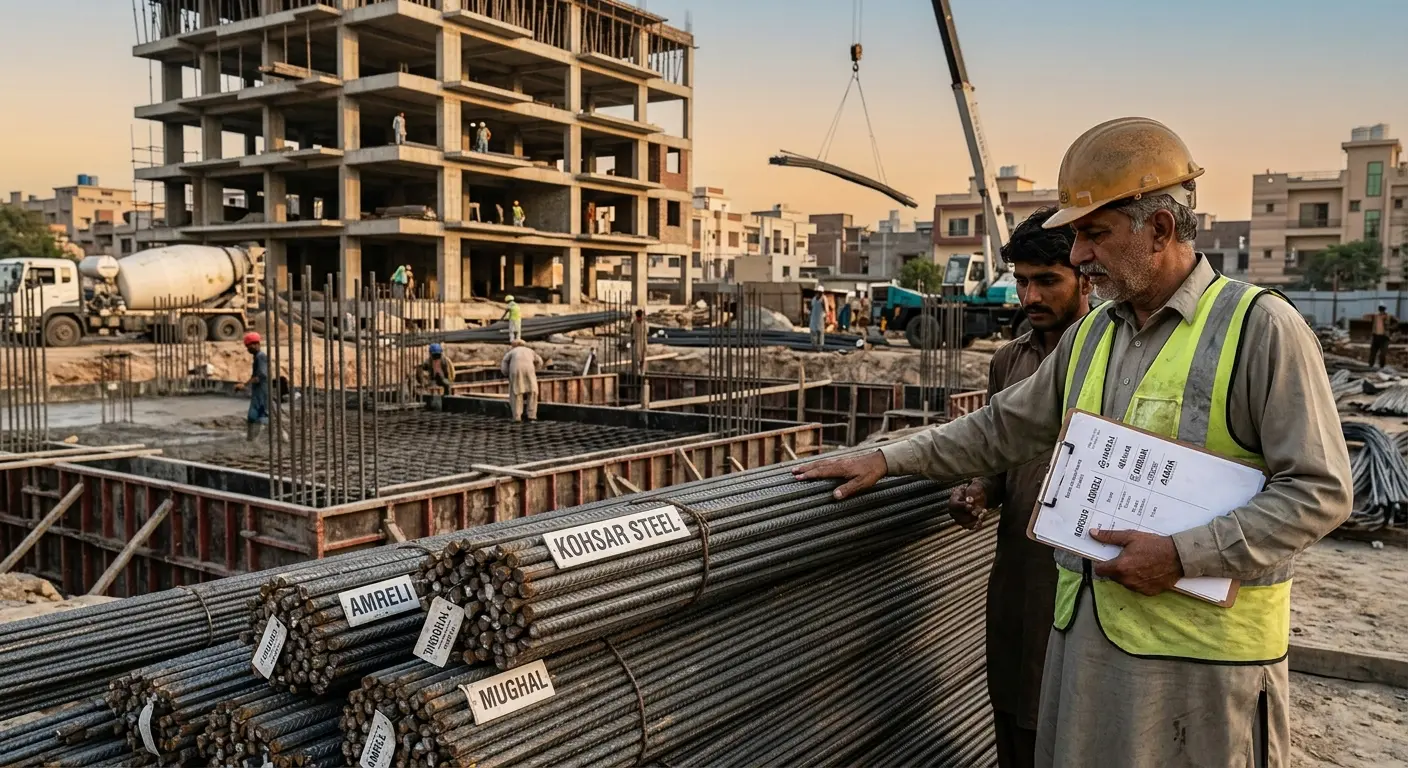
- Check manufacturer identification and bundle tags.
- Inspect the rebar rib pattern and surface condition.
- Measure the length and weight of representative bars.
- Compare the results with applicable nominal weights and tolerances.
- Request the mill test certificate.
- Match the heat number and other identifiers with delivery records.
- Review bend and tensile test results where required.
- Consult the supervising engineer if any results appear inconsistent.
Completing these checks can help you detect potential material problems before reinforcement is installed and concrete is poured.
Choose Quality Steel for Your Construction Project
Understanding how to check saria quality helps homeowners, contractors, and builders make better material purchasing decisions.
At Kohsar Steel Industries, steel manufacturing involves chemical testing, rolling, and physical testing processes. The company supplies Grade 40 and Grade 60 reinforcement products for construction applications in Pakistan.
Whether you are building a residential house or managing a larger construction project, choosing steel that meets the approved specifications is essential.
Contact Kohsar Steel Industries to discuss reinforcement requirements, product grades, and available technical documentation for your project.
Final Thoughts
Learning how to check saria quality is a valuable step toward safer and more reliable construction.
Start with the basics: inspect the rib pattern, verify weight per foot, check the grade and manufacturer identification, and review the mill test certificate.
For more complete quality assurance, rely on standardized bend tests, tensile tests, and the guidance of qualified construction professionals.
The best approach is to combine practical site inspection with verified material documentation and appropriate testing.
Build with confidence. Choose reinforcement steel that meets your project’s specifications, and speak with Kohsar Steel Industries about your construction steel requirements.