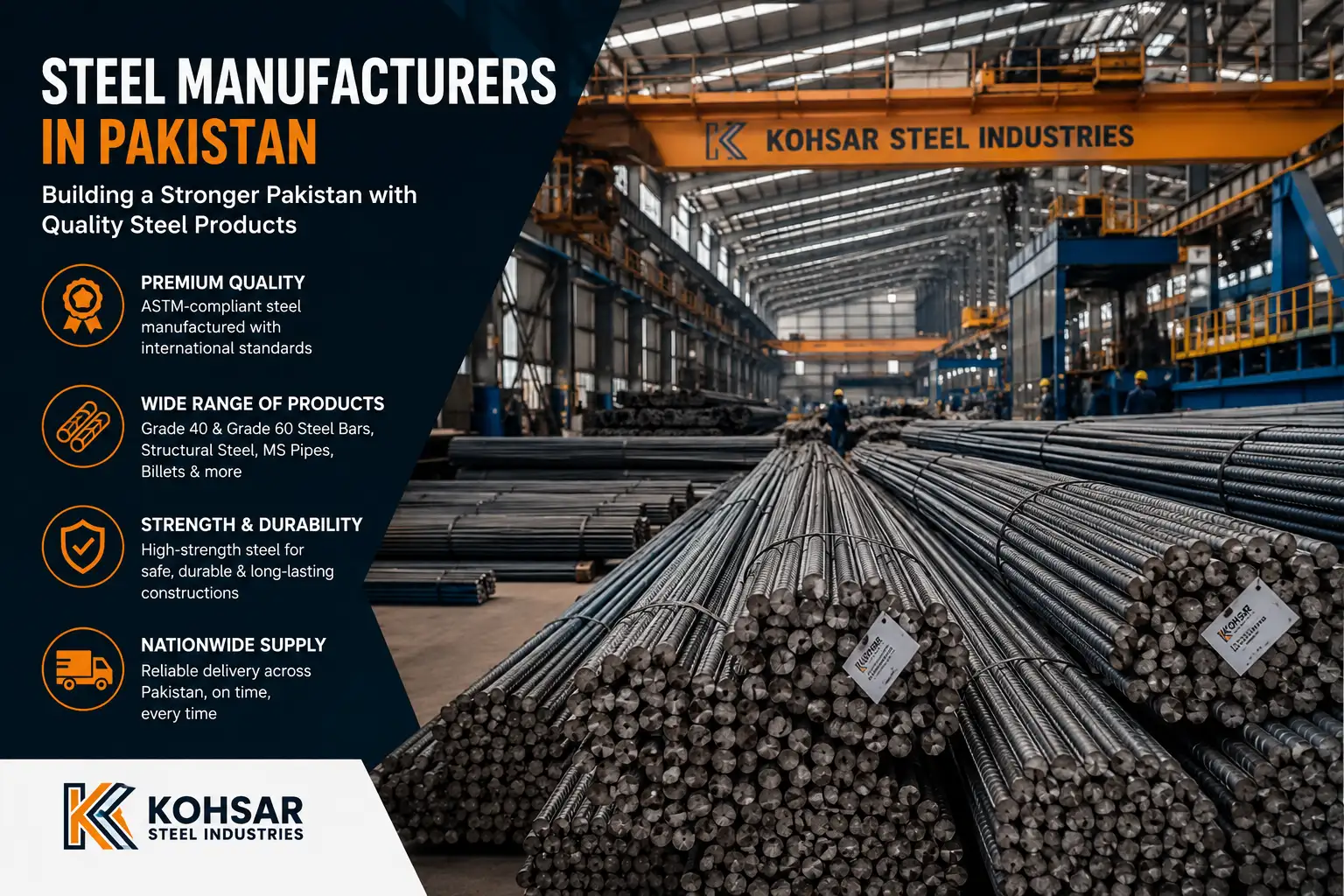
Choosing the right steel bar is one of the most important decisions in any construction project. Whether you are building a house, commercial building, bridge, foundation, beam, or other reinforced concrete structure, the type and grade of steel bars directly affect strength, durability, and structural performance.
But with terms such as deformed bars, Grade 40, Grade 60, ASTM A615, and ASTM A706, choosing the right reinforcement steel can quickly become confusing.
So, what are the different types of steel bars, and what do their grades actually mean?
In simple terms, steel bar types describe the physical form or application of the bar, while steel grades indicate important mechanical properties such as yield strength and tensile strength. Among the grades commonly discussed for construction, Grade 40 and Grade 60 are particularly important.
If you are looking for reliable steel bars in Pakistan, Kohsar Steel Industries provides Grade 40 and Grade 60 reinforcement steel along with other steel products for construction and industrial applications.
What Are Steel Bars?
Steel bars are long, solid sections of steel manufactured in different shapes, sizes, and grades. In construction, reinforcement steel bars, commonly called rebar or sariya, are primarily embedded inside concrete to improve its ability to withstand tensile forces.
Concrete is naturally strong under compression but comparatively weak under tension. Steel reinforcement helps overcome this limitation. When properly designed and placed, steel bars and concrete work together to create reinforced concrete structures capable of handling structural loads.
Steel reinforcement can be used in:
- Foundations
- Columns
- Beams
- Slabs
- Walls
- Footings
- Roads
- Bridges
- Industrial structures
- High-rise buildings
However, not every steel bar is the same. Differences in surface pattern, diameter, manufacturing method, strength, ductility, and applicable standards can make one bar more suitable for a particular application than another.
What Does a Steel Bar Grade Mean?
A steel bar grade primarily tells you about the mechanical properties of the steel.
Two of the most important properties are:
Yield strength: The stress at which steel begins to undergo permanent deformation.
Tensile strength: The maximum stress the steel can withstand while being pulled before failure.
For example, Grade 40 and Grade 60 represent different strength levels. Under the relevant ASTM specifications, Grade 40 has a minimum yield strength of 40,000 psi, while Grade 60 has a minimum yield strength of 60,000 psi.
This means that a higher grade generally provides greater yield strength—but that does not automatically mean it is the correct choice for every construction project. The required grade should always be determined according to structural design, applicable standards, and engineering requirements.
Main Types of Steel Bars Used in Construction
Steel bars can be categorized in several ways. One practical approach is to distinguish them according to their surface, shape, manufacturing characteristics, and intended application.
The most commonly encountered types include deformed steel bars, plain steel bars, cold twisted bars, and heavy round steel bars.
1. Deformed Steel Bars
Deformed steel bars are reinforcement bars with ribs, patterns, or other surface deformations along their length.
These surface patterns are not merely decorative. They are designed to improve the mechanical bond between the steel reinforcement and surrounding concrete.
When concrete hardens around a deformed bar, the ribs help resist movement between the steel and concrete. This makes deformed bars particularly useful for reinforced concrete structures where effective load transfer is essential.
Deformed steel bars are widely used in:
- Residential buildings
- Commercial buildings
- Foundations
- Columns
- Beams
- Slabs
- Bridges
- Infrastructure projects
For projects requiring reinforcement steel, selecting a manufacturer that maintains consistent dimensions and mechanical properties is important. You can explore deformed steel bars and other steel products available from Kohsar Steel Industries.
2. Plain Steel Bars
Plain steel bars have a smooth surface without the ribs found on deformed reinforcement bars.
Because they have a smooth surface, their bond with concrete differs from that of deformed bars. Their use depends on the requirements of the particular construction application and structural design.
Plain bars may be used in applications such as:
- Certain concrete reinforcement applications
- Small construction components
- Stirrups and ties in some designs
- Fabrication and general engineering work
The choice between plain and deformed bars should not be based simply on appearance or price. The structural drawings and applicable specifications should determine which type is appropriate.
3. Cold Twisted Bars
Cold twisted bars are steel reinforcement bars that undergo a cold-working process that changes their mechanical characteristics.
Historically, cold twisted reinforcement was used in construction as an alternative to conventional reinforcement bars. However, modern reinforcement systems and standards have increasingly emphasized controlled manufacturing, strength, ductility, and consistent quality.
When considering cold twisted bars for a project, it is important to verify that they meet the specifications required by the structural design and applicable construction standards.
4. Heavy Round Steel Bars
Heavy round steel bars are solid steel bars with a circular cross-section and are generally used where substantial material strength and dimensional requirements are needed.
Depending on their specification, these bars can be used in construction, fabrication, engineering, and industrial applications.
Their suitability depends on factors such as:
- Diameter
- Grade
- Chemical composition
- Mechanical properties
- Manufacturing standard
- Intended application
Understanding Steel Bar Grades
One of the most important aspects of reinforcement steel is its grade.
A steel bar’s grade helps identify its strength characteristics and allows engineers, contractors, and buyers to select material according to project requirements.
Among the grades frequently used and discussed in construction are Grade 40 and Grade 60.
Although the names may look similar, there is an important difference between them: their minimum specified yield and tensile strengths.
Grade 40 Steel Bars
Grade 40 steel bars have a minimum specified yield strength of 40,000 psi (approximately 280 MPa) under the relevant ASTM specification.
Their minimum tensile strength is 60,000 psi (approximately 420 MPa).
Grade 40 can be considered for applications where the structural design specifies this level of reinforcement strength.
Depending on engineering requirements, applications may include certain:
- Residential structures
- General reinforced concrete work
- Foundations
- Slabs
- Beams
- Other construction applications
However, the suitability of Grade 40 should always be determined by the project’s structural design rather than simply by the type of building.
For projects where Grade 40 has been specified, choosing steel from a manufacturer with proper quality-control and testing procedures is essential.
Grade 60 Steel Bars
Grade 60 steel bars provide a higher minimum yield strength than Grade 40.
Under the relevant ASTM specification, Grade 60 has a minimum yield strength of 60,000 psi (approximately 420 MPa) and a minimum tensile strength of 90,000 psi (approximately 620 MPa).
Because of their higher specified strength, Grade 60 bars can be used in structural applications where greater reinforcement strength is required.
They may be specified for:
- Commercial buildings
- Multi-story structures
- Heavier-load applications
- Infrastructure projects
- Reinforced concrete structures requiring higher-strength reinforcement
You can learn more about Grade 60 steel bars and their specifications before selecting them for a project.
Grade 40 vs Grade 60 Steel Bars
One of the most common questions when purchasing reinforcement steel is: What is the difference between Grade 40 and Grade 60?
The simplest answer is their specified strength.
Grade 40 has a minimum yield strength of 40,000 psi, whereas Grade 60 has a minimum yield strength of 60,000 psi. Grade 60 therefore provides a higher specified yield strength.
| Feature | Grade 40 | Grade 60 |
| Minimum Yield Strength | 40,000 psi / 280 MPa | 60,000 psi / 420 MPa |
| Minimum Tensile Strength | 60,000 psi / 420 MPa | 90,000 psi / 620 MPa |
| Relative Yield Strength | Lower | Higher |
| Typical Selection | Depends on structural design | Depends on structural design |
Is Grade 60 Better Than Grade 40?
Not necessarily.
It is tempting to assume that a higher-strength steel bar is automatically the better option. However, steel reinforcement should be selected according to the structural engineer’s specifications and the applicable construction standard.
If a structure has been designed for Grade 40 reinforcement, simply replacing it with Grade 60 without reviewing the design is not an appropriate approach.
Similarly, if a project requires Grade 60, using Grade 40 simply because it costs less may fail to satisfy the design requirements.
The right question is therefore not “Which grade is better?” but rather “Which grade is specified for my project?”
ASTM Standards for Steel Bars
Standards are another important part of choosing reinforcement steel.
ASTM specifications establish requirements that help define the chemical and mechanical characteristics, testing requirements, and other properties of steel products.
For buyers and construction professionals, standards provide an important reference when evaluating whether steel bars meet the requirements expected for a particular application.
Two ASTM specifications commonly associated with reinforcing bars are ASTM A615 and ASTM A706.
ASTM A615 Steel Bars
ASTM A615 covers deformed and plain carbon-steel bars used for concrete reinforcement.
It specifies requirements related to properties such as:
- Yield strength
- Tensile strength
- Elongation
- Bending
- Chemical composition and other requirements applicable to the specification
When purchasing reinforcement steel, buyers should verify the exact standard and grade required by their project rather than relying only on the product’s commercial name.
For a deeper look at applicable standards and specifications, see ASTM standards for steel bars.
ASTM A706 Steel Bars
ASTM A706 covers low-alloy steel bars intended for concrete reinforcement and places additional emphasis on properties relevant to controlled tensile properties and weldability.
This can make the specification particularly relevant for applications where the design requires specific mechanical characteristics or where welding considerations are important.
As with ASTM A615, the correct specification should be determined from the project’s structural requirements and applicable codes.
Common Steel Bar Sizes
Steel bar grade and size are two different things.
The grade relates primarily to mechanical properties, while the size generally refers to the bar’s nominal diameter.
For example, a project may specify:
- 12 mm Grade 40
- 12 mm Grade 60
- 16 mm Grade 40
- 16 mm Grade 60
In each example, the diameter can be the same while the specified grade is different.
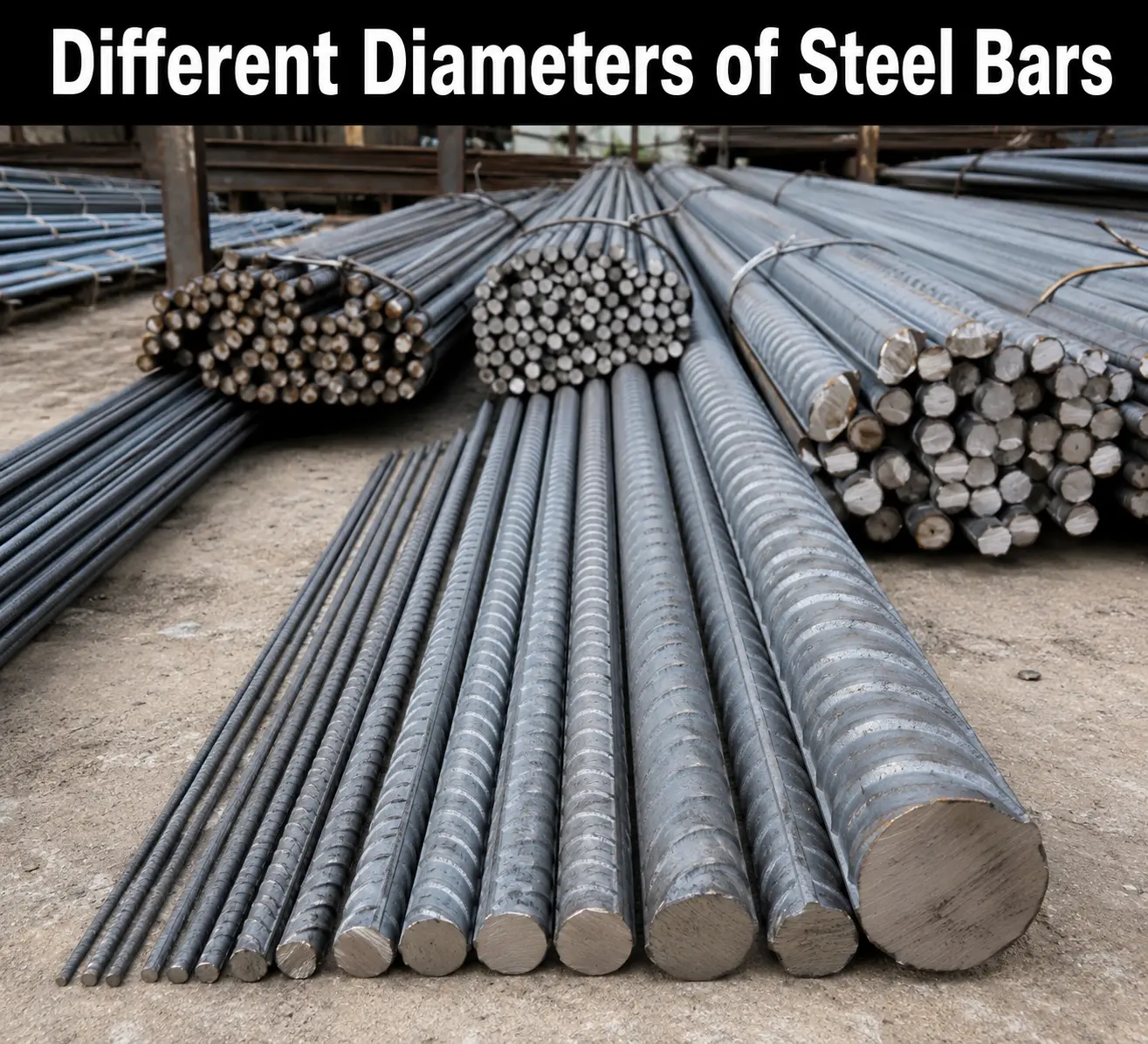
Common reinforcement bar diameters can include:
- 10 mm
- 12 mm
- 16 mm
- 20 mm
- 22 mm
- 25 mm
The required diameter, spacing, quantity, and grade should always follow the structural drawings and engineer’s specifications.
This distinction is important because a larger-diameter bar is not automatically a higher-grade bar, and a higher-grade bar is not automatically a larger bar.
Summary
Understanding the different types and grades of steel bars can make construction material selection much easier.
The most important distinction to remember is that steel bar type and steel bar grade are not the same thing. Deformed, plain, cold twisted, and round bars describe different physical or product characteristics, while grades such as Grade 40 and Grade 60 describe specified mechanical properties.
Grade 40 provides a minimum yield strength of 40,000 psi, while Grade 60 provides a higher minimum yield strength of 60,000 psi under the relevant ASTM specification.
But the higher number does not automatically make Grade 60 the right choice for every project. The correct reinforcement steel should always be selected according to structural drawings, engineering requirements, applicable standards, and project conditions.
Quality is equally important. Steel that meets the required grade and standard, comes with appropriate testing and certification, and is manufactured under reliable quality-control procedures can provide greater confidence throughout the construction process.
If you are searching for dependable reinforcement steel for your next project, explore Kohsar Steel Industries for Grade 40, Grade 60, ASTM-standard steel bars, and other steel products.