



Planning to buy steel for your home or construction project but confused about tons, tonnes, and maunds? You’re not alone! Many buyers in Pakistan come across different weight measurements when checking saria prices, comparing supplier quotations, or calculating construction materials. But here’s the important question:
Are you paying for the exact quantity of steel you’re receiving? Understanding Ton vs Tonne in Pakistan can make a significant difference when purchasing steel, especially in bulk. While some suppliers quote saria rates per kilogram, others use metric tonnes or traditional units like maunds.
Even a small misunderstanding can lead to incorrect calculations and unexpected expenses. In this article, we’ll explain the difference between ton, tonne, and maund, provide easy conversion formulas, and show you how to calculate steel prices accurately so you can purchase with confidence.
Ton vs Tonne in Pakistan: What’s the Actual Difference?
The terms ton and tonne sound almost identical, which is why many people assume they represent the same weight. However, their meanings can differ depending on the measurement system being used.
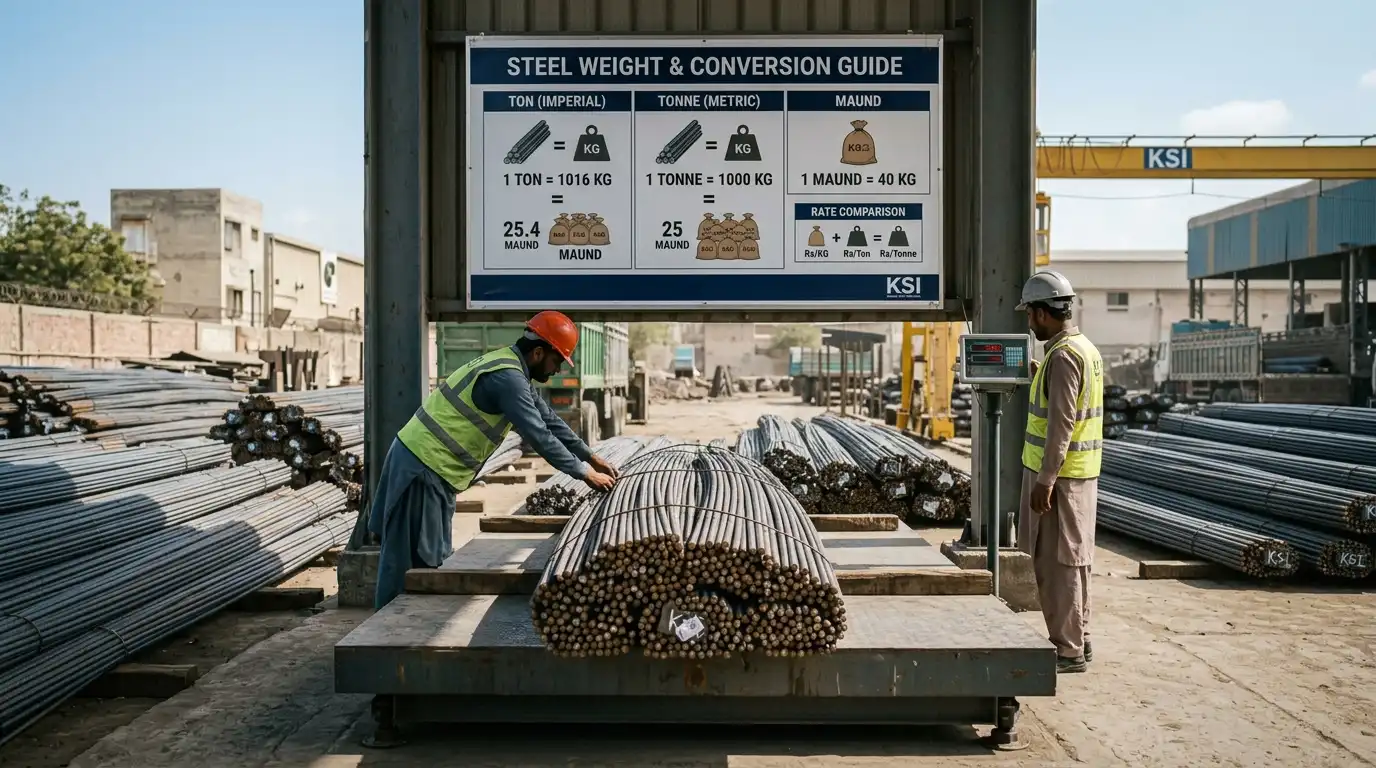
A tonne, also called a metric ton, is a standard unit of mass equal to exactly 1,000 kilograms. It is widely used in international trade, manufacturing, and the steel industry.
The word ton, on the other hand, can refer to different measurements. In the United States, a short ton equals approximately 907.185 kilograms, while the British imperial long ton equals approximately 1,016.047 kilograms.
In Pakistan’s steel market, suppliers commonly use ton to mean a metric tonne. However, buyers should always confirm the measurement unit mentioned in a quotation or invoice.
Metric Tonne vs Short Ton: Are They Equal?
No. A metric tonne and a short ton are not equal, and the difference becomes important when purchasing large quantities of steel.
| Measurement | Weight in kilograms |
| 1 Metric Tonne | 1,000 kg |
| 1 US Short Ton | 907.185 kg |
| 1 UK Long Ton | 1,016.047 kg |
For example, if you order 10 metric tonnes of steel, you should receive 10,000 kilograms. However, 10 US short tons equal approximately 9,071.85 kilograms.
That’s a difference of more than 928 kilograms!
This is why understanding metric ton vs. short ton is essential, particularly when reviewing international quotations or purchasing materials from suppliers using different measurement systems.
What Is a Maund in Pakistan?
A maund, commonly called mann in Urdu, is a traditional unit of weight used in Pakistan. Although the metric system is widely used for industrial and commercial measurements, maunds remain familiar in agricultural markets and everyday trading conversations.
In common Pakistani trade usage:
1 Maund = 40 KG
Common Pakistani trade convention
This means 5 maunds equal 200 kilograms, while 10 maunds equal 400 kilograms.
Why Do Some Buyers Still Use Maunds?
Many people are familiar with traditional weight measurements and find them easier to understand. For example, a buyer may ask a supplier for the price of 25 maunds of steel instead of requesting one metric tonne.
Both quantities represent the same weight when the 40-kilogram maund convention is used.
However, because historical and regional definitions of a maund have varied, it is important to confirm that the supplier is using 40 kilograms per maund.
For accurate commercial transactions, buyers should request the final quantity in kilograms or metric tonnes.
Ton, Tonne, Maund and KG Conversion Table
Whether you’re calculating steel requirements for a small house or a large construction project, knowing basic weight conversions can save time and prevent mistakes.
Here is a quick reference table for maund to kg, tonne to maund, and other common steel weight conversions.
| Weight unit | Kilograms | Maunds (40 kg) |
| 1 Maund | 40 kg | 1 |
| 5 Maunds | 200 kg | 5 |
| 10 Maunds | 400 kg | 10 |
| 20 Maunds | 800 kg | 20 |
| 1 Metric Tonne | 1,000 kg | 25 |
| 2 Metric Tonnes | 2,000 kg | 50 |
| 5 Metric Tonnes | 5,000 kg | 125 |
| 10 Metric Tonnes | 10,000 kg | 250 |
Easy Formulas for Steel Weight Conversion
You don’t need complicated calculations to convert between these units.
- Maund to KG: Multiply the number of maunds by 40.
- KG to Maund: Divide the number of kilograms by 40.
- Metric Tonne to KG: Multiply the number of tonnes by 1,000.
- Metric Tonne to Maund: Multiply the number of tonnes by 25.
For example, if your contractor requires 3 metric tonnes of steel:
3 × 1,000 = 3,000 kg
3,000 ÷ 40 = 75 maunds
Therefore, 3 metric tonnes of steel equal 3,000 kilograms or 75 maunds.
How Is Steel Sold in Pakistan: Per KG, Maund or Tonne?
When purchasing steel in Pakistan, you’ll notice that suppliers may display prices using different weight units. The quotation format often depends on the order quantity, supplier, and type of transaction.
Understanding these pricing methods makes it easier to compare offers and estimate your construction expenses.
1. Saria Rate Per KG
The saria rate per kg is a convenient pricing method for smaller purchases and everyday construction budgeting.
For example, if steel costs Rs. 250 per kilogram, purchasing 100 kilograms would cost:
100 × Rs. 250 = Rs. 25,000
This method is useful when buying limited quantities of reinforcement bars or calculating material costs for individual construction tasks.
2. Saria Rate Per Ton
For larger orders, steel manufacturers and suppliers commonly quote prices per metric tonne.
The saria rate per ton generally represents the cost of 1,000 kilograms when the quotation uses metric tonnes.
For example, at Rs. 250 per kilogram:
1,000 × Rs. 250 = Rs. 250,000 per metric tonne
You can check the steel price per ton in Pakistan on the Kohsar Steel Industries website to review listed prices for different reinforcement steel grades and sizes.
3. Steel Pricing Per Maund
Some local buyers may prefer to discuss steel quantities in maunds because the unit is familiar.
If the price is Rs. 250 per kilogram, one 40-kilogram maund would cost:
40 × Rs. 250 = Rs. 10,000
Although maunds are useful for informal calculations, buyers should confirm that the final invoice clearly states the weight in kilograms or metric tonnes.
How to Calculate Saria Price Per Ton and Per KG
Calculating steel prices becomes much easier once you understand the relationship between kilograms, maunds, and metric tonnes. Whether you’re purchasing a few steel bars or ordering material for an entire building, converting quotations into a common unit helps you compare prices accurately.
How to Convert Saria Rate Per KG Into Per Ton
Suppose a supplier quotes Grade 60 saria at Rs. 255 per kilogram.
To calculate the price per metric tonne, multiply the kilogram rate by 1,000.
Rs. 255 × 1,000 = Rs. 255,000 per metric tonne
Similarly, if a supplier quotes Rs. 255,000 per metric tonne, divide that amount by 1,000 to find the kilogram rate.
Rs. 255,000 ÷ 1,000 = Rs. 255 per kg
How to Calculate Steel Price, Per Maund
Using the same hypothetical rate of Rs. 255 per kilogram:
Rs. 255 × 40 = Rs. 10,200 per maund.
Here’s a comparison of steel costs at this example rate:
| Quantity | Total steel cost |
| 1 kg | Rs. 255 |
| 1 maund (40 kg) | Rs. 10,200 |
| 5 maunds (200 kg) | Rs. 51,000 |
| 10 maunds (400 kg) | Rs. 102,000 |
| 1 metric tonne (1,000 kg) | Rs. 255,000 |
| 5 metric tonnes (5,000 kg) | Rs. 1,275,000 |
These prices are hypothetical examples for explaining calculations. They do not represent current Kohsar Steel Industries rates. Taxes, freight, and other applicable charges are excluded.
The key is to compare quotations using the same weight unit. Otherwise, two suppliers may appear to offer different prices simply because they are using different measurements.
How to Verify Steel Weight Before Purchasing
Knowing the correct conversions is only the first step. You should also verify that the steel quantity delivered matches your order.
Confirm the Weight Unit on Your Quotation
Before placing an order, ask whether the quoted price applies to kilograms, metric tonnes, or another unit. Ideally, the quotation should specify the total weight in kilograms.
Check Steel Bar Sizes and Specifications
Steel reinforcement bars come in different diameters, and their theoretical weight per metre varies according to their size.
For example, a 16 mm reinforcement bar has a greater theoretical weight per metre than a 12 mm bar of the same length.
This is why comparing the number of steel bars alone is not enough. Buyers should also check the diameter, length, grade, and specified weight.
You can explore Kohsar Steel Industries’ steel products and specifications to learn more about the company’s reinforcement steel offerings.
Request Weight Documentation
For larger purchases, ask your supplier for appropriate weight documentation, such as a weighbridge slip or delivery challan showing the quantity supplied.
Where applicable, check whether the recorded weight is gross weight, tare weight, or net steel weight.
Also ensure the invoice matches the agreed quantity, steel grade, and unit price.
Taking these precautions helps you receive the correct material quantity and manage your construction budget more confidently.
Closing Note
Understanding Ton vs Tonne in Pakistan is essential for anyone purchasing steel for residential, commercial, or industrial construction. While a metric tonne equals 1,000 kilograms, a maund commonly represents 40 kilograms, meaning one metric tonne contains exactly 25 maunds.
Knowing these conversions helps you compare saria rates, calculate material costs, understand supplier quotations, and avoid expensive purchasing mistakes.
At Kohsar Steel Industries, we believe informed buyers make better construction decisions. Whether you’re planning a small residential project or purchasing reinforcement steel in bulk, understanding weight measurements is an important part of choosing the right materials.
Looking for quality reinforcement steel for your next construction project? Explore the steel products available at Kohsar Steel Industries or contact our team to discuss your requirements, confirm product specifications, and request an updated quotation.
FAQs
Q 1. Ton How Many KG in Pakistan?
Ans: In Pakistani steel trade, one ton commonly means one metric tonne, which equals 1,000 kilograms. However, a US short ton equals approximately 907.185 kilograms. Always confirm the unit used by your supplier.
Q 2. Maund How Many KG in Pakistan?
Ans: One maund commonly equals 40 kilograms in Pakistani trade. Therefore, 5 maunds equal 200 kilograms, and 25 maunds equal 1,000 kilograms. This guide uses the standard 40-kilogram trade convention.
Q 3. Ton Mein Kitne Maund Hote Hain?
Ans: Pakistan mein agar 1 ton se murad metric tonne ho, to 1 ton mein 25 maund hote hain.
The calculation is simple: 1,000 kg ÷ 40 kg = 25 maunds.
Q 4. Maund Mein Kitne KG Hote Hain?
Ans: Pakistan mein aam tor par 1 maund mein 40 kilogram hote hain. For example, 2 maunds equal 80 kilograms, while 10 maunds equal 400 kilograms.
Q 5. Ton Aur Maund Mein Farq Kya Hai?
Ans: Ton aur maund dono wazan naapne ki units hain, lekin inki quantity alag hoti hai. Pakistan mein 1 metric ton 1,000 kg aur 1 maund 40 kg ke barabar hota hai. Therefore, one metric tonne contains 25 maunds.
Q 6. How Do You Convert Saria Rate Per Ton Into Saria Rate Per KG?
Ans: Divide the price per metric tonne by 1,000. For example, if steel costs Rs. 260,000 per metric tonne, its price per kilogram is Rs. 260, excluding any additional charges not included in the original quotation.